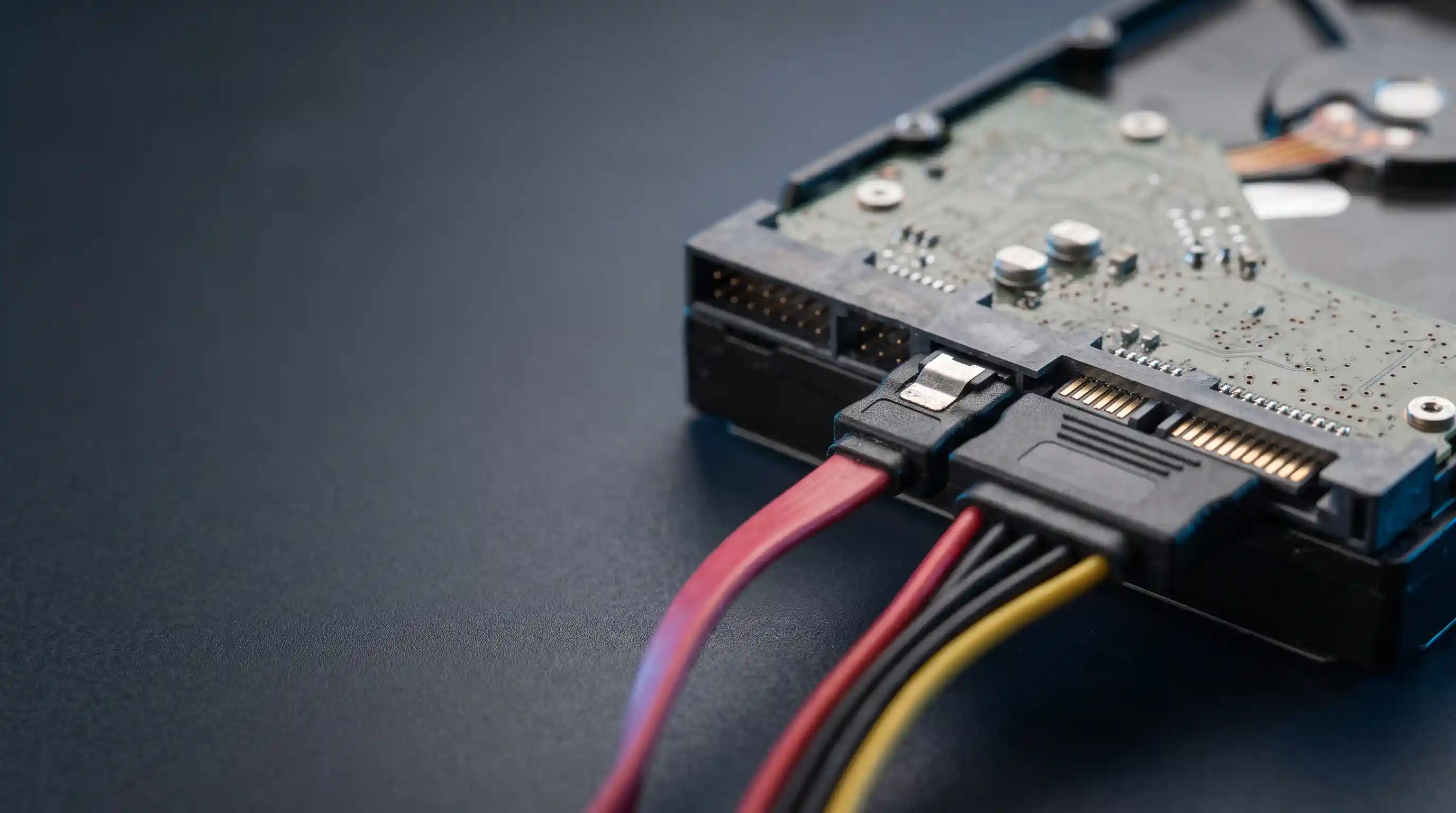
In short: hard drives got more expensive because of demand from data centers building infrastructure for artificial intelligence. Large cloud companies have booked almost all HDD production for 2026, and the flash memory shortage has pushed SSD prices up too, so there is no cheap alternative either. In Ukraine, on top of that, drives are imported and their price is tied to the exchange rate.
Status as of October 2026. The market is changing, so we update this article every quarter.
Reason 1. AI data centers are buying up drives years in advance
Training and running artificial intelligence models requires enormous storage: training data, model copies, logs, video and images. The cheapest way to store volumes like these is high-capacity hard drives (so-called nearline HDDs), so cloud giants are buying them in unprecedented quantities.
Manufacturers have confirmed this publicly. In January 2026, during the report for the second quarter of the fiscal year, Western Digital CEO Irving Tan said the company had practically sold out its production capacity for the entire 2026 calendar year. According to him, the seven largest customers have firm orders for 2026, and long-term agreements running to 2027 and 2028 have been signed with some of them. Seagate reported that its nearline drive capacity is fully allocated for 2026.
Their own reports show how far the manufacturers' focus has shifted: at Western Digital the cloud segment accounted for 89% of revenue, and the consumer segment for just 5%.
Reason 2. Production cannot be increased quickly
Hard drives are made by only three companies today: Western Digital, Seagate and Toshiba (more in the article "HDD manufacturers"). Building new lines takes years, and manufacturers are betting on higher capacity per drive rather than on the number of drives. So even with record demand there are no more units on the market, and priority goes to those who ordered early and in large batches.
Reason 3. SSDs got more expensive too, and some buyers went back to HDDs
The same AI boom caused a shortage of RAM and flash memory: manufacturers moved part of their capacity to memory for server accelerators. As a result, SSDs and RAM went up in price even earlier and more sharply than hard drives. Some buyers who planned to switch to SSDs stayed with HDDs as the cheapest way to store data, which further supports demand.
Reason 4. The Ukrainian factor: imports and currency
Hard drives are not manufactured in Ukraine, so all of them are imported. The price in hryvnias therefore depends not only on the global price of the drive but also on the exchange rate, logistics costs and customs payments. Any rise in global prices reaches Ukraine with some delay: stock bought earlier sells out first, and new batches arrive at new prices.
Will hard drive prices fall
Not in the near future. Manufacturers have already signed agreements for 2027 and partly for 2028, and analysts expect prices to level off gradually rather than drop sharply. Short-term discounts on individual models are possible, but the market does not forecast a return to 2025 prices in the coming months.
It is important to understand that the shortage hits high-capacity drives for data centers hardest. Small consumer models are getting more expensive too, but it is the large capacities that manufacturers reserve primarily for cloud customers.
What buyers should do now
- If you need a drive, do not put off buying it in the hope of lower prices. Forecasts do not promise a fast price drop, and a drive that has started failing may not last that long.
- Calculate the capacity you need precisely, not "with a big margin". At current prices the difference between 2 and 4 TB is noticeable. How to work out the capacity for your tasks is covered in "What HDD capacity to choose".
- For an old PC or laptop, look at smaller capacities. A 500 GB to 1 TB drive often does the job completely for much less money: 500 GB hard drives, 1 TB.
- Do not save money on the use case. A cheaper desktop drive in a video recorder or NAS will not last as long and will cost more in the end. Model comparisons for different tasks are in our ranking of the best HDDs of 2026.
- Be careful with "cheap new" drives. With the shortage, refurbished or used drives sold as new turn up more often. How to check a drive in 5 minutes after it arrives is explained in "How to check a new hard drive".
Sources
Western Digital: report for the second quarter of fiscal 2026 and investor conference call (January 29, 2026). Seagate: CEO comments on the allocation of nearline capacity for 2026. Industry reviews of the memory and storage market for 2025-2026.